Wednesday, June 15, 2011

Redistricting 2012 - MA - Picking and Choosing Who Stays in Congress and Who Goes – Will the Dead Rise to Save Seats?


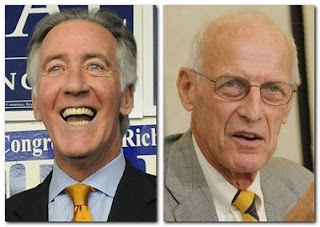
Should I Stay or Should I go Now? (Clash for obvious reasons) Olver and Neal Square off to Retain Seats - image Masslive.com


With the 2010 census released and redistricting committees across the nation drawing new lines down to the individual city precincts and wards, there will be occasions when those states controlled by a majority of Democrats, and with or without an “independent redistricting panel”, will have to make tough choices as to who stays and who goes in Congress. An article today in Politico: “California redistricting may pit Dem vs. Dem” speaks to the obvious – when cutting seats from Congress due to losses in population, or, as in the case in California, shifts in population end up combining a district and creating new districts, resulting in a similar scenario – there will be winners and losers – the fact remains that the total number of seats in Congress remains the same, however, the makeup of the districts and how they are drawn by committees can result in “gerrymandering” – whereby lines are drawn to include pockets of population that are either heavily Democrat or Republican, forming in effect a guarantee that a specific party will remain in power in these states until the next census.

The biggest losers in the quest for political power on both the state and national level are: New York and Ohio (losing 2 Congressional seats each), Iowa, Illinois, Missouri, Michigan, Louisiana, Pennsylvania, New Jersey and Massachusetts (all losing one seat). For the most part, these are states that tend to trend Democrat (source: Washington Post House Seat Changes by State ). The biggest winners are: Texas with 4 seats, Florida with 2, Georgia, South Carolina, Arizona, Utah, Nevada and Washington all picking up one House Seat.

In general the redistricting must be in place for the 113th congress, or by the 2012 elections. In Massachusetts, as ward and precincts bosses struggle to maintain an advantage over their own City or Town council seats, the bigger question arises as to which Congressional Democrat will no longer be walking the Halls of Congress? In the latest round, all eyes are on Western Massachusetts where the population has always been lower, given the greater land mass and lack of highly populated municipalities. A meeting in early June in with “officials”, noted that in order for the 1st Congressional District to avoid being swallowed by the second and/or third, they would need to come up with 80,000 additional residents.(WAMC) This is no mean feat, considering that moving vans out of Massachusetts are the norm given the state’s high tax rate and lack of incentives for employers. Therefore, logic follows that either John Olver in the 1st District or Richard Neal in the 2nd will be forced to retire as districts are merged - both the 2nd and the 3rd districts (seat currently held by McGovern), need an additional 60,000 plus bodies in order to remain a qualified Congressional District. In order for Democrats to maintain control over the remaining two districts, larger population centers from the 2nd district would be merged into either the 1st and or the 3rd in order to maintain balance. As hard as either Neal or Olver lobby to stay in power (or more appropriately, keep the seats they have held for a multitude of terms), it is apparent that those on the State Redistricting Committee, are not looking East in order to slice and dice a district west of Worcester.

Republicans in Massachusetts (yes, they exists) who may be considering a run for Congress, considering the incredible showing in the 2010 elections (minus the dead and missing voters), are patiently waiting to see how these lines will be drawn and which remaining Congressional Democrat will be the target of a challenge. In the 2010 elections, there were several hotly contested seats: the 2nd, 4th and 10th specifically. In the 2nd district, Richard Neal, incumbent Democrat, was expected to win by a landslide, and although win he did, it was not without a lot of help from last minute voter drives, coupled with robo calls from Bill Clinton, and a lot of dinners for Senior citizens. Originally predicted by the New York Times to maintain his seat with a 75% advantage over the Republican Candidate, Tom Wesley, an entirely different scenario occurred, Wesley garnered over 40% of the vote. In fact, looking at the interactive map here courtesy of the New York Times it appears that the biggest winner was in the Western Part of the State was Olver, who won by a margin of 60 to 34.9%,. Other big winner were: McGovern in the 3rd by 59 to 39%, Markey in the 7th by 66 to 33%, and Stephen Lynch by 58 to 26%. However, the balance of the districts with the exception of one which went unchallenged, were more competitive: the 2nd Neal: 57 to 43%, Tierney, 56 to 43, Tsongas in the 5th, 54 to 43, Barney Frank 54 to 44, and the 10th district, Keating 46 to 42%. (NYTimes) Given the fact that these races were all predicted to be “blowouts” for the incumbents, and that the challengers were all first time challengers, the results are stunning.

Further, in the 2009 special election, whereby Scott Brown won over Martha Coakley by 5 points, all eyes were on Massachusetts, in the 2010 election, literally no one was keeping an eye on the polls; What is troubling in this aspect is that Secretary of State, Democrat William Galvin, had refused to remove an estimated 116,000 dead voters from its rolls which if one were to look at the math comprised enough ballots to push those incumbents over the top. What is most interesting is that Galvin, , when pressed, refused to remove those ineligible voters from the rolls.

This was prior to the special election, again, but not without understanding that over 217 Republicans were running for city, state and federal office, an historical first, in the 2010 elections. Therefore, one wonders, when will Massachusetts clear its voter’s rolls of the dead and missing (those moved to other states)? Also is this endemic to Massachusetts or would other states where certain parties feel that perhaps their power might be threatened by a change of voters hearts (specifically in states like Massachusetts where 51% of the voting block is independent, or unenrolled, literally outnumbering both the Democrats and Republicans), keep those dead and missing on record, an insurance policy so to speak.

That said, in Massachusetts, should it come down to a split between the 1st, 2nd and 3rd, one would except that Neal will maintain his seat, alongside McGovern, although given the previous vulnerability, if one were a Democrat, one would be thinking, maybe not – give it to Olver and McGovern who guarantee (based on 2010 election results) an easy victory.

As this must be completed, later this year, in time for campaigns to form and for voters to be informed of changes to districts, and wards and precincts (where one might vote), it should be announced fairly soon. None of the aforementioned (specifically Barney Frank and Richard Neal, who both held fairly high positions in the U.S Congress, and Frank, who was, in partnership with one Senator from Connecticut (retired) Dodd, on the Fannie and Freddie meltdown, (the cause of our current economic crisis), are now, well, an afterthought – still managing to get press and bring the occasional dollar home (i.e. spending taxpayers’ dollars), however, with the current historical GOP control, and the promise (given the makeup of the other states that picked up seats) they will continue to be in the minority – it’s math not rocket science or the media saying otherwise. (I.e. wishful thinking that Congress will be returned to Democrat control anytime within the next say decade.

For more information on the Process from the State of Massachusetts visit: www.malegislature.gov/District/Committee One should noticed those that will be making the final decision, are not necessarily bi-partisan.

Tuesday, June 14, 2011

CNN GOP Debate – Pawlenty, Bachmann and Romney Score with Media, Missing: Sarah Palin – Waiting for Pal and the Fall Debates


Sadly Missed at CNN Debate: Sarah Palin - image Zimbio.com


CNN held their first 2012 GOP debate, with a field of 7 candidates answering blazing fast questions from an obviously partisan network – the final analysis of the debate from David Gergenopined that Mitt Romney and Michelle Bachmann were the clear winners of the debate, but questions whether this debate will help the GOP to win the White House – seriously.
Gergen’s take:

As to the individual candidates, Romney had a clear, easy-to-understand message and he stuck to it: Barack Obama has failed as president. Other candidates said much the same thing but with less consistency.


Obviously, if one has read even a paragraph of Ann Coulter’s latest tome, “Demonic”, and the premise would be defined by a picture of Gergen as the poster child. (The Book: Strongly recommended, strikingly brilliant and Available on Amazon.com).
From the perspective of one of who believes the only people watching the debate were either political junkies or campaign managers and the opposition team, there is another point of view. Romney appeared to rehash the 2008 campaign talking points, and lacked substance outside of the many slogans which peppered his retorts. Bachmann and Pawlenty clearly had the most concise and compelling answers, given the fact that the moderator and debate format did not allow more than :30 seconds for each candidate to respond and, in the case of Herman Cain, went so far as to “rep-word” a response to the point where it no longer resembled exactly what Mr. Cain said: Although he corrected the moderator, it was obvious to those with half a brain that the CNN team was taking cues from MSNBC (no need for further edification).

How much trouble in the Obama in as far as the obvious falling approval ratings, the economy moving further into the tank (with reasonable people understanding that at best, a two to four year recovery with radical cuts and corporate tax breaks will be necessary to right the otherwise sinking ship), brings out former White House Press Secretary, Gibbs as his campaign “surrogate”.

The most obviously and patently clear response to the process came from Herman Cain regarding the field of contenders pointing out exactly how early it was in the process.

The two “players” to watch at the moment, for the moment, to this mind are Michelle Bachmann (who may have stunned more than a few people when she suggested dismantling the EPA, a statement that was obviously referring to the ridiculous practices of the bureaucracy that kills industry to protect any obscure form of fish and or fauna in any given area of the nation, spending millions in the process, while killing jobs at the same time. The minnow, however, appears to trump sanity.)

Pawlenty, steady, straight forward and specific on each answer, appeared to be more substantive than his male counterparts. One thing about Pawlenty that was noticeable, he does indeed have a personality, and one must concede the point, he’s offers individual voters the opportunity to assess the “safe and steady” side of the GOP. Is his economic growth plan a bit aggressive, most certainly, however, he has one, and it is, despite the screaming from the left, doable.

After Carter, the nation needed radical reforms, including tax increases (which were temporary) in order to kick start the economy. What the nation needs now, is a surgeon, not a rock star, who will be as aggressive as possible in order to bring jobs, industry and the less is more approach to the mix.

The problem with both Bachmann and Pawlenty is that they show leadership and that may not play well in Washington. For a kind article on Pawlenty from the host network: CNN’s “How Pawlenty's life story prepared him for possible White House run”.

On the flip side, watching the debate one was constantly waiting for more: there was obviously something or someone missing from the mix (and this mix, contrary to the constant drumbeat, is a good cross section of conservatives with plenty to offer), is one Sarah Palin. Palin with Bachmann declared, would bring two of the strongest conservative with any gumption to the stage, and although it is this opinion that Sarah Palin would shine in this area, without her, Bachmann managed to keep it lively, how much more livelier would it be? Debates that make on want to grab a cup of coffee (CNN’s last night), rather than a debate that makes one want to grab the popcorn is what is needed – Palin brings that.

She’s become somewhat annoying, however, to the press, since the revelation that her recently released emails (perfectly timed as they showed her to be an apt, and reasonable leader) are ”Annoyingly Gaffe-Free” (Los Angeles Times). The problem is that the Times, in this instance, cannot understand how this can be? Therefore, there must be a reason: the premise, the emails were heavily redacted by the State of Alaska therefore, there must be something missed.

The fact that her emails are written at an 8th grade level is Big News! However, take the column that is noting Palin’s obviously 8th grade level emails, and copy and paste into any copy of Microsoft word and be amazed – those journalists are writing at: an 8th grade level.

Rick Perry would bring the State of Texas, red meat Republican; factor to the stage, after suggesting that the state of Texas secede and seriously assert state’s rights, Perry would be entertaining.

Pawlenty did note that Palin was obviously qualified to be President and had the audacity of honestly in answering the question, of which, not one of the other “men” on the stage would dare to opine. Bachmann of course, would have her own reason for wanting Palin off the stage, perhaps, as they are similar in ideology, with the exception that Palin is better spoken, less rigid ideologically and more experienced in the debate arena. Which is why, to this mind she was missed.

The final analysis: pointing to Romney as the front-runner this early in the race, is clearly not a complement, as one understands that early front-runners generally are sent into oblivion. (Although his “guy in high school most would want to see fail” appearance has improved with the rolled up sleeves and jeans, his newly sported, less than perfect debate “coiffe”, came off less tasseled and more “mad scientist”.) Should Palin, (please!) enter the area, al-la George Bush circa 1999, say in late August, it would shake things up a bit. Keep in mind that in early polling Palin still comes in behind Romney, however, the most recent Gallup poll showed that Romney’s lead might be shortenned up a bit by several factors including additional public appearances and continued use of slogan, leaving the 20 plus percent who had not previously made a selection of any candidate, jumping to support Palin, Bachmann and Pawlenty.

Why? They appear to be the least “Washington”, the most “Genuine” and the most capable of the bunch. Of course, this is an analysis based on watching the debate, rather than being associated with CNN in any way. Additionally, how much more enhanced would the field be should two or even three women enter the fray, especially since, it has been noted, these women have the ability to speak their minds in a way that makes the GOP male field (and any other candidate in this upcoming election) appear a bit “less than capable” – perhaps this feminist is biased, but more than one male commentator has noted that the aforementioned have more, politely put: chutzpah, than their male counterparts. What we need is a leader, and in this time and in this case, one has to have faith that the old boys club no longer can hold sway over the electorate – regardless of political party.

Monday, June 13, 2011

Education Stimulus Expires and No Child Left Behind On Back Burner Puts Public Ed on Notice – What if Education Were “Set-Back” to 1960’s levels?

Politico asks the question: “Will cuts threaten education funding?” – and goes on to speak to the “$100 Billion” in aid to public schools that was written into the short-term Stimulus – as “fading away”. The short-term Stimulus allowed states to bolster their individual education programs by hiring or staving off layoffs for teachers in public school systems, however, the focus on keeping or increasing the number of teachers did little to improve the quality of education, or, for that matter even maintain an average. The 2011 Department of Education – “Nation’s Report Card”, will be released in September, the 2009 Report, was based on 11 out of 50 states, and showed an “improvement” over 2005 scores.

The 2009 Report, therefore, fell outside of the “stimulus”, and those 11 states scores were not particularly “stellar” – The scoring, based on a high of 500 points, shows the average score at 221, compared to 1992 when the average was at 217, or in simple mathematical score: a grade of 55.8 – or F - our students, with increased spending, are failing.

In a “snapshot” of the nations scores (PDF) – focused on the following score gaps: Females scored higher than males (see any significant changes there from the 1960’s?), Black and Hispanic Students performed at 25% below their “white” counterparts, and those eligible for “free lunch” were at 26% below other students. (What is of note in this particular study: DC, which offers a school voucher program scored in the higher percentile with 14 other states: most below the “Mason Dixon line”, with the exception of Alaska – which, is interesting in that the southern states were, in the past, given less in aid to education than their northern counterparts, and are considered traditionally “Conservative” in nature (sic: Republican).

This tells us that there have been no significant changes in education, despite increased funding, in the past 30 years – (see treatment here on education standards today versus 1970) so what gives?

There should be a study done of the differences between private parochial and public schools at every level, and then the federal government might want to stand up and take notice, and back off. Of course, keep in mind the reading statistics were based on the eleven states that participated, however, when one compares the costs of educating a student in a private parochial high school where the graduation rate is 100% and 98% of those students are on their way to a four year college at a cost per year to the parents of approximately $8,000, plus books and uniforms, to a public school in the same district where the average cost is approximately $12,000, and Massachusetts shows scores at reading levels that are (out of the 11 states), pretty much an “F” on average.

One has to question how, a private non-union, parochial school with regulations regarding dress and demeanor, and respect for teachers, can out-perform a public school which has more funding per student? Perhaps it is due to the focus on the student rather than the educator and the constant need for increased funds for programs to aid those students that may be in an “underperforming class” (i.e. male, black, Hispanic, or free lunch), rather than on actually teaching all students and demanding some respect. By contrast, as parochial schools are inclusive of males, blacks and Hispanics, as well as students that are not from families that have scads of cash (i.e. grants and financial aid are available), and the performance rate is obviously stellar, it begs a lot of unanswered questions – except in DC where they have school vouchers and families of students in underperforming public schools are allowed to opt out and into a performing parochial school. (Granted taking money from those public schools and paying a parochial school less for the same basic service.)

No Child Left Behind gets a lot of blame as the “Republican” plan – however another article in Politico on the subject suggests that the program will be cut – or actually expire in 2011 - The Act, which was the brainchild of both President George W. Bush and the late Senator Edward M. Kennedy (which makes one wonder how the “Republican Tag” became attached to the act when the most liberal Senator of our times, the Lion of the Senate, was in the entire act.) That said, standardized tests, the premise of the ACT, apparently is a huge burden to those states attempting to educate children to at least an “F” in reading – and the costs take away from other programs.
Flashback to the 1950’s, 1960’s where standardized testing was the norm – and students were not taught to a test (as in Massachusetts where students are taught to the “MCAS” to increase performance) rather they were taught, assessed and categorized, those who excelled given a pat on the back and those who failed were given special education status. Students were taught basics, and respect.

Were all districts the same? No – therefore, busing was instituted, students from underperforming schools were bused to districts where performance and funds were higher, instead of doing the obvious: giving aid to those inner city schools and bringing them up to snuff and leaving the other performing districts alone. See Boston school busing riots in the 1960’s.

Therefore, although it would be a wonderful world if every student was “college material” in grade speak, regardless of race or ethnicity or socio-economic background the facts remain that there will continue to be disparity - it is a fact of life – a student’s ability to learn is seriously hampered only by the fact that they are treated as a “special class” due to race and ethnicity, whereas, when in a private setting, there are no factors, only equal treatment – of course, in order to be in that particular setting, parents must a) pay out of pocket or procure loans or grants to keep their students in parochial schools and b)those students must work to remain in those schools and show respect to their teachers, who teach – instead of hoping on a plane to Madison WI to protest a 6% increase suggested by a Republican governor in the WI public school teachers contributions to their health care plans!


Would it not behoove those teachers to be in school, in their own districts, teaching? Teaching not to color, gender or ethnicity, rather teaching reading, writing and arithmetic, testing students on performance and then demanding that students do their part? (Granted factors such as teen pregnancy, and the inability to be proficient in English should be taken into account: 1) should be discouraged at all costs, and 2) see immersion at the parochial level that brings all students up to English proficiency faster than the Rosetta Stone series.) Therefore this utopian thought surfaces, if the education funding at the Federal Level is cut, and the quality of education is set back to the stone age (i.e. 1950, 1960’s and 1970’s) the worst thing that can happen is our students will once again be among the top in the world – one final note in this utopian idea, teachers would be heavily vested in teaching, which is a calling, and a profession, and those that excelled would be given increased salary and “tenure” while those than didn’t perform were given the boot.


This is of course, an opinion based solely on personal experience and the opinion of this blog, and a few statistics from that MASS DOE and archived articles on education pre-1970.

Amazon Picks

Massachusetts Conservative Feminist - Degrees of Moderation and Sanity Headline Animator

FEEDJIT Live Traffic Map

Contact Me:

Your Name
Your Email Address
Subject
Message