Showing posts with label John Olver. Show all posts

Wednesday, June 15, 2011

Redistricting 2012 - MA - Picking and Choosing Who Stays in Congress and Who Goes – Will the Dead Rise to Save Seats?


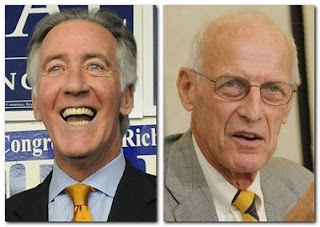
Should I Stay or Should I go Now? (Clash for obvious reasons) Olver and Neal Square off to Retain Seats - image Masslive.com


With the 2010 census released and redistricting committees across the nation drawing new lines down to the individual city precincts and wards, there will be occasions when those states controlled by a majority of Democrats, and with or without an “independent redistricting panel”, will have to make tough choices as to who stays and who goes in Congress. An article today in Politico: “California redistricting may pit Dem vs. Dem” speaks to the obvious – when cutting seats from Congress due to losses in population, or, as in the case in California, shifts in population end up combining a district and creating new districts, resulting in a similar scenario – there will be winners and losers – the fact remains that the total number of seats in Congress remains the same, however, the makeup of the districts and how they are drawn by committees can result in “gerrymandering” – whereby lines are drawn to include pockets of population that are either heavily Democrat or Republican, forming in effect a guarantee that a specific party will remain in power in these states until the next census.

The biggest losers in the quest for political power on both the state and national level are: New York and Ohio (losing 2 Congressional seats each), Iowa, Illinois, Missouri, Michigan, Louisiana, Pennsylvania, New Jersey and Massachusetts (all losing one seat). For the most part, these are states that tend to trend Democrat (source: Washington Post House Seat Changes by State ). The biggest winners are: Texas with 4 seats, Florida with 2, Georgia, South Carolina, Arizona, Utah, Nevada and Washington all picking up one House Seat.

In general the redistricting must be in place for the 113th congress, or by the 2012 elections. In Massachusetts, as ward and precincts bosses struggle to maintain an advantage over their own City or Town council seats, the bigger question arises as to which Congressional Democrat will no longer be walking the Halls of Congress? In the latest round, all eyes are on Western Massachusetts where the population has always been lower, given the greater land mass and lack of highly populated municipalities. A meeting in early June in with “officials”, noted that in order for the 1st Congressional District to avoid being swallowed by the second and/or third, they would need to come up with 80,000 additional residents.(WAMC) This is no mean feat, considering that moving vans out of Massachusetts are the norm given the state’s high tax rate and lack of incentives for employers. Therefore, logic follows that either John Olver in the 1st District or Richard Neal in the 2nd will be forced to retire as districts are merged - both the 2nd and the 3rd districts (seat currently held by McGovern), need an additional 60,000 plus bodies in order to remain a qualified Congressional District. In order for Democrats to maintain control over the remaining two districts, larger population centers from the 2nd district would be merged into either the 1st and or the 3rd in order to maintain balance. As hard as either Neal or Olver lobby to stay in power (or more appropriately, keep the seats they have held for a multitude of terms), it is apparent that those on the State Redistricting Committee, are not looking East in order to slice and dice a district west of Worcester.

Republicans in Massachusetts (yes, they exists) who may be considering a run for Congress, considering the incredible showing in the 2010 elections (minus the dead and missing voters), are patiently waiting to see how these lines will be drawn and which remaining Congressional Democrat will be the target of a challenge. In the 2010 elections, there were several hotly contested seats: the 2nd, 4th and 10th specifically. In the 2nd district, Richard Neal, incumbent Democrat, was expected to win by a landslide, and although win he did, it was not without a lot of help from last minute voter drives, coupled with robo calls from Bill Clinton, and a lot of dinners for Senior citizens. Originally predicted by the New York Times to maintain his seat with a 75% advantage over the Republican Candidate, Tom Wesley, an entirely different scenario occurred, Wesley garnered over 40% of the vote. In fact, looking at the interactive map here courtesy of the New York Times it appears that the biggest winner was in the Western Part of the State was Olver, who won by a margin of 60 to 34.9%,. Other big winner were: McGovern in the 3rd by 59 to 39%, Markey in the 7th by 66 to 33%, and Stephen Lynch by 58 to 26%. However, the balance of the districts with the exception of one which went unchallenged, were more competitive: the 2nd Neal: 57 to 43%, Tierney, 56 to 43, Tsongas in the 5th, 54 to 43, Barney Frank 54 to 44, and the 10th district, Keating 46 to 42%. (NYTimes) Given the fact that these races were all predicted to be “blowouts” for the incumbents, and that the challengers were all first time challengers, the results are stunning.

Further, in the 2009 special election, whereby Scott Brown won over Martha Coakley by 5 points, all eyes were on Massachusetts, in the 2010 election, literally no one was keeping an eye on the polls; What is troubling in this aspect is that Secretary of State, Democrat William Galvin, had refused to remove an estimated 116,000 dead voters from its rolls which if one were to look at the math comprised enough ballots to push those incumbents over the top. What is most interesting is that Galvin, , when pressed, refused to remove those ineligible voters from the rolls.

This was prior to the special election, again, but not without understanding that over 217 Republicans were running for city, state and federal office, an historical first, in the 2010 elections. Therefore, one wonders, when will Massachusetts clear its voter’s rolls of the dead and missing (those moved to other states)? Also is this endemic to Massachusetts or would other states where certain parties feel that perhaps their power might be threatened by a change of voters hearts (specifically in states like Massachusetts where 51% of the voting block is independent, or unenrolled, literally outnumbering both the Democrats and Republicans), keep those dead and missing on record, an insurance policy so to speak.

That said, in Massachusetts, should it come down to a split between the 1st, 2nd and 3rd, one would except that Neal will maintain his seat, alongside McGovern, although given the previous vulnerability, if one were a Democrat, one would be thinking, maybe not – give it to Olver and McGovern who guarantee (based on 2010 election results) an easy victory.

As this must be completed, later this year, in time for campaigns to form and for voters to be informed of changes to districts, and wards and precincts (where one might vote), it should be announced fairly soon. None of the aforementioned (specifically Barney Frank and Richard Neal, who both held fairly high positions in the U.S Congress, and Frank, who was, in partnership with one Senator from Connecticut (retired) Dodd, on the Fannie and Freddie meltdown, (the cause of our current economic crisis), are now, well, an afterthought – still managing to get press and bring the occasional dollar home (i.e. spending taxpayers’ dollars), however, with the current historical GOP control, and the promise (given the makeup of the other states that picked up seats) they will continue to be in the minority – it’s math not rocket science or the media saying otherwise. (I.e. wishful thinking that Congress will be returned to Democrat control anytime within the next say decade.

For more information on the Process from the State of Massachusetts visit: www.malegislature.gov/District/Committee One should noticed those that will be making the final decision, are not necessarily bi-partisan.

Wednesday, December 22, 2010

Massachusetts Redistricting Games Begin – Democrats Would be Best Served by Merging 10th and 4th Districts – Analysis


Odd man out? 10th District Newly Elected Bill Keating (D-) - Photo DCCC.org


In what the Boston Globe is dubbing”a game of survival” between the Massachusetts Congressional Delegation one name that does not pop up in the initial articles regarding the loss of one U.S. House seat in the Bay State, is that of newly elected 10th District Representative, Democrat Bill Keating. In the 2010, 9 of the 10 Congressional districts were challenged, with Keating invested in the most competitive race in the State; he narrowly won victory over Republican Challenger, Jeff Perry. Although Richard Neal (D-MA2) and Barney Frank (D-MA4) had to campaign for “their” seats for the first time in decades, they managed to garner a 10 point lead over their challengers, Republican newcomers, Tom Wesley and Sean Bielat respectively. (The anticipated outcome by the New York Times for the MA2 district was Neal 71%/Wesley 26%, with the actual results of Neal 57% to Wesley’s 43%. The highest percentage of returns went to Olver (MA1) 60%, Markey (MA7) 67%, and Lynch (MA) with 68%. The most vulnerable and holding the smallest district in size and population appears to be Keating – the 10th District, which is also known to be stronger for Republican’s, encompasses Cape Cod, and would, therefore, be an easy and natural merger with the MA4th. The Democrats do benefit from a bit of extra press, in all the posturing, Neal and Olver have received more press in the Local Media over redistricing than they did during their 2010 campaigns.

Democrats could easily “kill two birds with one stone” by merging the 4th and 10th, adding the larger Democrat friendly urban areas of New Bedford and a large section of Fall River to the smaller towns and villages on the Cape. One, they reduce the political opportunities for a challenger to the Democrat Controlled Seat, and would save the nation’s highest profile Congressional Representative, Barney Frank, from extinction.
Although rumors of Frank’s retirement have been constant over the past few election cycles, the legislator fought tooth and nail in 2008, and would, one would gather, be the last one of the current delegation to retire. Frank is a Democrat Icon, revered by the Progressives, and the target of Conservatives would focus on Frank in any upcoming election, essentially taking the heat off Representatives such as Tierney (scandal: his wife made the 5 top political scandals list for her indictment in a mob related money laundering schemeduring the 2010 campaign). Niki Tsongas (D-MA5) would be safe as the “token” woman, (Massachusetts being such a stalwart champion of women’s rights under Democrat rule.)

Deval Patrick, Democrat Governor, is still, according to CBS3 Springfield MA holding to the myth that the Democrat Congressional Delegation from Massachusetts will continue to have clout in the Congress, even with the redistricting. Although Massachusetts is somewhat of an “island unto itself”, and therefore, many who hold higher office may have missed the fact that the balance of the 49 states (with few exceptions), elected a majority of Republicans to the Congress, and almost managed to take the Senate in 2010. Those Congressional Representatives who survived in Massachusetts, including the Govenor, did so with either narrow margins (Patrick did not win a 2nd term by mandate, he won over Baker, by 3 points, (see addition of 3rd candidate, Democrat turned independent, turned Democrat, Tim Cahill in Governors Race), or with a lot of help from unions and community service organizations getting out the vote in a massive 13 hour attempt, as it appeared that an extra 20,000 voters were needed here and there in order to maintain the total Democrat advantage.

The Massachusetts Democrats, who pulled out of these races, went to a lame duck session of Congress only to find that the clout they once had, appears to have disappeared. Neal, (D-MA2) who was vying for the Chair of the Ways and Means, and then after the loss of Democrat Power, was vying for ranking member – lost that honor to Sander Levin of MI. Both Neal and Olver, however, are reliable progressive votes. Therefore, it would appear that the only reason one would consider eliminating a Western Massachusetts District over a merger of the 4th and 10th Districts, would be that one currently holds a seat out towards Boston, and Boston traditionally treats Western Massachusetts as a source of tax revenue, nothing more, nothing less.

That said, according to an article from PBS station, WBUR, it is Washington who will have the final say, not Beacon Hill. If that is the case, then the new Minority Leader, Nancy Pelosi will have some input into the decision as to which seat to “cut”. Considering how close the former Speaker is to Frank and Neal and Olver, it is doubtful that, if this is correct, any one of those aforementioned would be added to the unemployment rolls.

Therefore, as the Boston Globe and those East of the Worcester Line, begin to eye two Western Massachusetts Districts, for more taxes and a Congressional seat, they may want to take a look at the new kid on the block, and the advantages of a 4th and 10th district merger.

What else is in involved in a redistricting effort? There are state representatives that will lose “careers” regardless of which District is merged or redrawn, and this is where Beacon Hill comes into play. With the Governors ties to the Administration, as strong as they are, his stated “minimal” involvement in the process versus State Legislators slated to redistrict the Commonwealth, one would gather that his input from Washington as to who stays and who goes in Congress would trump any fights on Beacon Hill for state representatives positions.

Of note: Secretary of State William Galvin (D), has called for an independent counsel to decide the redistricting according to the Globe and was summarily told where that idea might be shelved by Massachusetts Senate President Therese Murray and Massachusetts House Speaker DeLeo. Incidentally, the Senate President hails from Plymouth which is part of the 10th District.

Thursday, December 02, 2010

Richard Neal (D-MA2) Plans to Run for Re-Election in 2012 – Despite Possible Redistricting and Loss of Congressional District


Richard Neal(D-MA2) and John Olver (D-MA1), May have to run for new combined district seat in 2012 - photo Springfield Republican.

From: Masslive.com (Springfield Republican) – Congressman Richard Neal (D-MA2) announced yesterday that he would seek re-election to Congress in 2012. Neal has held the seat since 1989 and faced his first challenge in 2010 in Republican Tom Wesley, a political newcomer who garnered 40% of the vote in the district, exceeding pundit’s expectations showing Neal as powerhouse taking 75% of the vote. There will be several challengers to Neal’s seat in 2012, however, that will depend upon the Commonwealth’s redistricting due to a significant loss in population forcing the loss of a Congressional seat. As of this time, it is unclear which district will be lost in the state, with some speculation that the 1st and 2nd districts will be merged, having the lowest populations.

Massachusetts has lost population consistent with increased taxes and joins other similarly high tax states in losing seats. From urbangrounds.com via Washington Examiner:

New York and Ohio are likely to lose two seats each, while Illinois, Iowa, Louisiana, Massachusetts, Michigan, Missouri, New Jersey, and Pennsylvania will be down one apiece. The average top state personal income tax rate in these loser states: 6.05 percent.


Therefore, Neal, who had been vying for the top slot on the Ways and Means Committee prior to the Nov. 2nd election which saw an historical power shift in the House, with Democrat losses the highest since the 1930’s, is now relegated to “ranking member”, with the possibility of the current district, east of Springfield, being merged with part of the 3rd district held by McGovern, leaving the 1st District alive and well under the direction of John Olver who will face an in party challenge from Berkshire Register of Deeds and former state Sen. Andrea F. Nuciforo Jr., a Pittsfield lawyer, is running for the 2012 Democratic nomination for the seat and has a fund-raising event scheduled for Thursday.

With the possibility of the District Loss, Neal may have to face a three way primary challenge against fellow Congressman John Olver (D-MA1) and Nucifero. Neal, a former schoolteacher, first ran for elected office in 1984 and won the seat as Mayor of Springfield, he was elected to the Congress upon the retirement of Democrat Edward Boland, facing no opposition in 1989. Neal, who has been dubbed “Nancy Pelosi’s and Irelands Tax-Man on the Hill” votes straight party line 98% of the time. In the waning hours of the 111th Congress, Neal and other House Democrats plan to force a vote on tax cuts, proposing the Progressive model of increasing taxes on all businesses and income over $250,000 while negotiations between the White House and Senior members of the House and Senate are still taking place. A purely political stunt designed to embarrass the incoming majority. The Bush Tax Cuts are set to expire on the 1st of January, with an across the board increase in taxes for all Americans. The Democrats in both Houses and the Administration appear to be stalling and allowing these tax increases to go through, which will, in all likelihood extend the current economic crisis. The blame will rest solely on those who failed to move this issue forward over the past two years, and, Neal, who held a high ranking seat on the Ways and Means Committee, had the power to do so.

Monday, October 18, 2010

2010 Mid-Term - MA1 & MA2 Congressional Districts: Incumbents Richard Neal (D-MA2) and John Olver (D-MA1) Decline Debates – Debate Video and Analysis

Springfield, MA: On Sunday, October 16, WWLP, the Springfield, MA NBC affiliate held two debates, one for the MA1st and one for the MA2nd Congressional Districts. Both incumbents, Richard Neal (D) and John Olver (D) declined the invitation to meet their opponents, Tom Wesley(R) who is running for the MA2 Congressional District and Bill Gunn(R) and Michael Engle (I) who are running for the MA1 Congressional District in a Lincoln Douglas style debate. The videos from WWLP are shown below. Congressman, Richard Neal did accept one debate with opponent Tom Wesley, in a pre-tapped ½ hour moderated debate on WGBY, Public Television, podcasts of the debate here are not yet available; the last airing was yesterday morning at 10:30 am. WWLP, however, offers a larger share of the districts viewing audience, even though the debates are held during the afternoon (The affiliate makes all debates available on their website.)

Incumbents are declining to debate across the country, most notably, Nancy Pelosi, Speaker of the House, who is refusing the debate her opponent, John Dennis. Although the strategy to pretend one does not have competition for one’s Congressional seat, might appear to be a good idea, especially in MA and CA, where “reliable Democrats” are counted on to get out and vote, the issues facing the nation, high unemployment, specifically, do not allow that luxury this election cycle. The facts that races are rated safe Democrat by CQ Politics (Congressional Quarterly), Richard Neal is considered “Safe Democrat”, based on his 2008 election, where there race was not contested. In addition CQ factors in the results from the 2008 presidential election, in order to further emphasis their hypotheses The same is true of the MA1st and the CA8th. However, one has to recall that other elections have taken place (special elections) in MA where those statistics tell a different story. For example: Scott Brown (R), bested Martha Coakley (D) by up to 57% in most MA Congressional Districts, therefore the data is skewed to favor the incumbent.

One can check the rating of their respective representatives on an interactive map available here , however, Massachusetts Districts, will show, for the most part, the information available from 2008. These ratings are used by a variety of websites, to support the fact that the incumbents are likely to be reelected. Using historical data, is, normally speaking; a safe bet, however, to not acknowledge the current mood of the electorate or the fact that these Congressional Representatives have actual challengers is irresponsible to say the least.

That said, WWLP, in giving both Tom Wesley and Bill Gunn and Independent Candidate Engle an opportunity to debate (or in Tom Wesley’s case, answer the moderators questions, in some detail) allows those in the district and opportunity to learn more about each candidate, however, it does little good for the incumbent to appear either too arrogant or too busy, to take the time for their constituents. In addition, the incumbents do not have the ability to rebut any statements made, which appears to put the respective representatives at a clear disadvantage, as more of the electorate are engaged. It is worth watching both debates for the MA2 and MA1 shown below due to the variety of ideas on issues from unemployment, taxation and the nations deficit that are offered by these candidates.

Video's below courtesy of WWLP, local news/infocus the Debates Note: videos not available on WWLP's You tube channel.


Thursday, September 30, 2010

MA 2010 Election Update – Roll Call of Dems who Voted to Stay in Session to avoid Tax Increase in 2011 – Not One Mass. Rep. on the List!

The House voted to adjourn yesterday and put aside voting on legislation that would have prevented a tax increase come January, 2011. Those Democrats voting to stay in Session, along with all Republicans are shown below. Who’s missing? Every single Democrat Congressional Representative from the Commonwealth of Massachusetts – who voted with House Speaker, Nancy Pelosi (who cast the vote that put the House on mini-vacation) to come home and campaign. One more reason why anti-incumbent sentiment is running high in Massachusetts are stunts like this.

Putting one’s “career” over the interests of the tax payers is a problem; therefore, when the opportunity arises, in every district in the Commonwealth, the question should be poised:
“Why, Congressmen, (or woman) did you vote to come home and campaign, instead of saving me from paying more taxes? Followed by: “and why should you keep your job?”


Every single member of the House of Representatives (your congressional representative) and Senator knew that allowing the Bush Tax cuts to expire would mean your income would decrease, yet the people we hired decided their income was more important – they needed to get back to their districts to campaign. Was it each and every single Congressional Representative or Senator – hardly. In fact, the House of Representatives passed the motion to adjourn and not vote on the Bush Tax Cuts by one vote – the tie breaker - Speaker of the House, Nancy Pelosi.

That means that thirty nine Democrats joined all Congressional Republicans in voting to stay in session and vote on your income. Those Democrats who joined all Republicans and voted no are:

AL Bright
AZ Giffords
AZ Kirkpatrick
AZ Mitchell
CA McNerney
CO Markey
GA Marshall
ID Minnick
IL Bean
IL Foster
IN Donnelly
IN Ellsworth
LA MeLancon
MD Kratovil
ME Michaud
MI Peters
MI Schauer
MS Childers
MS Taylor
NC McIntyre
NC Shuler
NH Arcuri
NJ Adler
NM Heinrich
NV Titus
NY Bishop
NY McMahon
OH Driehaus
OH Kilroy
OH Space
PA Altmire
PA Carney
PA Murphy
PA Perriello
PA Sestak
SD Sandlin
TX Edwards
VA Connolly
VA Nye


If your Democrat Congressman or Congresswoman is not on the above list, they are responsible for increasing your income. Nothing more, nothing less.

Sunday, August 22, 2010

Election 2010 - Massachusetts - How Many Long Held Democrat Congressional Seats will be Held by Republicans come November?

There is a change in the political think of the voters in the Bay State, and as stated before, this was in evidence prior to Scott Brown’s run at the Senate. Once that run was successful, those districts that had one or two Republicans who had stepped forward to run for Congress suddenly had multiple candidates vying for primary win. In addition, where there had been no opposition previously, opposition did develop. The question one has to ask is how viable are those “predictions of Massachusetts, deeply entrenched, Democrats being defeated in November?” or for that matter, all districts as “Safe Democrat” – In reality, there are several seats where it is more than possible, and heading towards highly probable that they are in play – this based on limited access to internal polls, as well as a general angst of the people in the Commonwealth over the Party in Power. Although there has been this type of voter emotion before, which allowed Ronald Regan to claim the Bay State twice, one has to understand the Congressional and Senate seats remained in the hands of the Democrats.

What has changed? Several points to consider: this is a mid-term not a general election where the focus is more on the Presidential candidates than on those running for Congress, the aforementioned angst which is fueled by high deficits, and unemployment, as well as a “brand” gone bad – sets the stage for an electorate that is ready to try something different. (Which has happened, although, admittedly rarely.)

The make-up of the Bay State’s electorate is considered in the equation as the majority of the electorate is “unenrolleds” (50 plus percent), and although the Republican Party in Massachustts has the lowest registration of the two major parties, it is being now being boosted by those Green Party, Libertarian and unenrolleds and yes, Scott Brown Democrats, who, as national polls indicate, are not buying slogans.

Lacking any public polling, which may or may not take place until after the September 14, primary, it is difficult to call a specific race, but one can, based on the aforementioned, make a prediction.
Over at Wicked Local (Gatehouse Media) a guest op-ed piece by Robert E. Kelly opines that “Single Party Reign Could End in Massachustts. Mr. Kelly then goes on to rate which districts he feels are in jeopardy – basing his predictions on the outcome of the Brown/Coakley Senate Race, and including the caveat that that voter angst must stay the same to see these predictions come to fruition.

If anything, as of this writing, Massachusetts voters are more a) interested in politics earlier in the game, and especially who is running against whom, and b) the angst is increasing daily. To read the entire article visit: Wicked Local, Swansea News Opinions

Mr. Kelley’s Predictions with this blogs comments:

On District 1, Mr. Kelly feels this may be in play – a point where this blog departs. The reasoning, that district (using Mr. Kelly’s model) was 99.9% for Coakley against Brown, and Congressman Olver is Massachusetts version of Robert Byrd. Is it possible, yes, anything is possible, but probable? Unless there is a huge turn in voter angst (pitchfork level), the Challenger, one William Gunn, will have his work cut out for him.
District 2- Incumbent Richard Neal as vulnerable – this is agreed. Neal is extremely vulnerable – to the point where he has called in Bill Clinton to stump for him in the districts largest population centers: Chicopee and Springfield, where Neal has the biggest problems. Odds are on the winner of the Republican Primary to go to Washington – This district should be polled come October 1st.

District 3 – McGovern – agreed also endangered – Worcester Country has become somewhat of a red streak in the Middle of the blue Bay State for the past few election cycles. This District should be polled.

District 4 – Although incumbent Barney Frank is probably the most high profile target of the angst felt in the Bay State and elsewhere, within his own district, he has the distinction of being likeable – at least up until this year. In order for a challenger to unseat Barney – whichever Republican emerges from the Primary must have a) scads of cash to counter Frank, and boots on the ground, specifically in the larger population centers where the ground game needs to be focused.
What makes this race interesting is that there does exists a schism in the Democrat Party itself, where Rachael Brown is running against Frank, coupled with rumors of Frank’s retirement. Therefore, this district is one where anything can happen, and it makes for extreme political entertainment. Frank can be bested, by a Republican but the effort will have to be herculean – and then, it may not be Frank rather a Democrat by the name of Rachel Brown facing the Republican in November - Until the primary – this is anyone’s best guess.

District 5- Niki Tsongas – agreed – this district is in play, District 6 – Agreed Safe (for now), District 7 – Markey is one of the powerful players in this Democrat Congressional Delegation– somewhat possible, but not probable. District 8 – Stephen Lynch – disagree with the assessment – Lynch is safer than most and District 9 – Capuano – running virtually unopposed – safe. Finally, District 10 – Free-for-All, seat will go to a Republican – agreed.

Therefore, although looking at these races, sans national polling data, but based on voter angst, electorate make-up and (in the case of Mr. Kelly) the Brown-Coakley outcome) one can get a better picture of the Commonwealth’s political make-up and possible representation after the November 4th mid-term. In any event, the Commonwealth should be one of the more interesting states to watch in October, as several of these races are definitely in play.


MA Congressional District Predictions As of August, 2010 - (This is illustrative - understanding blogger has no graphic skills)

Wednesday, May 28, 2008

Nathan Bech (R) Challenges Olver for 1st Congressional District (MA)


Nathan Bech

Nathan Bech is challenging John Olver’s Congressional seat this year. Olver has held this seat for the past 17 years and epitomizes Massachusetts Progressive politics exported nationally. The 1st Congressional District is the largest district in the state of Massachusetts in area, and includes the noteworthy cities of Northampton and Amherst (often dubbed by locals as NoHo and The People’s Republic of Amherst). Those two areas, in particular make up Olver’s core constituency. The rest of district is fairly grounded in reality (considering this is Massachusetts). Bech lists his top priorities as the economy, healthcare and Iraq, with environment, education, immigration, taxes, government waste, energy, second amendment, national security, veterans and the sanctity of life to follow. Note: he takes a strong conservative, yet moderate stand on all issues and is worth consideration: pro-choice, border control, simplified taxes and cutting taxes for the middle class, and of specific interest to this household, tax credits for parents choosing to enroll children in parochial or private schools. To learn more about Nathan Bech and his stand on the issues, go to: NathanBech.com

Some interesting statistic on the makeup of the Massachusetts Electorate: From the Cape Code Times a listing by Cape county (a slightly progressive part of the state) shows that the unerolled in the state make up more than 50% of the electorate. A great deal will depend on the state's unenrolled in 2008 - should they vote moderately, those congressional and senate seats currently being challenged could, if supported by the party, export Massachusetts conservatism to the nation - for a change.

Amazon Picks

Massachusetts Conservative Feminist - Degrees of Moderation and Sanity Headline Animator

FEEDJIT Live Traffic Map

Contact Me:

Your Name
Your Email Address
Subject
Message